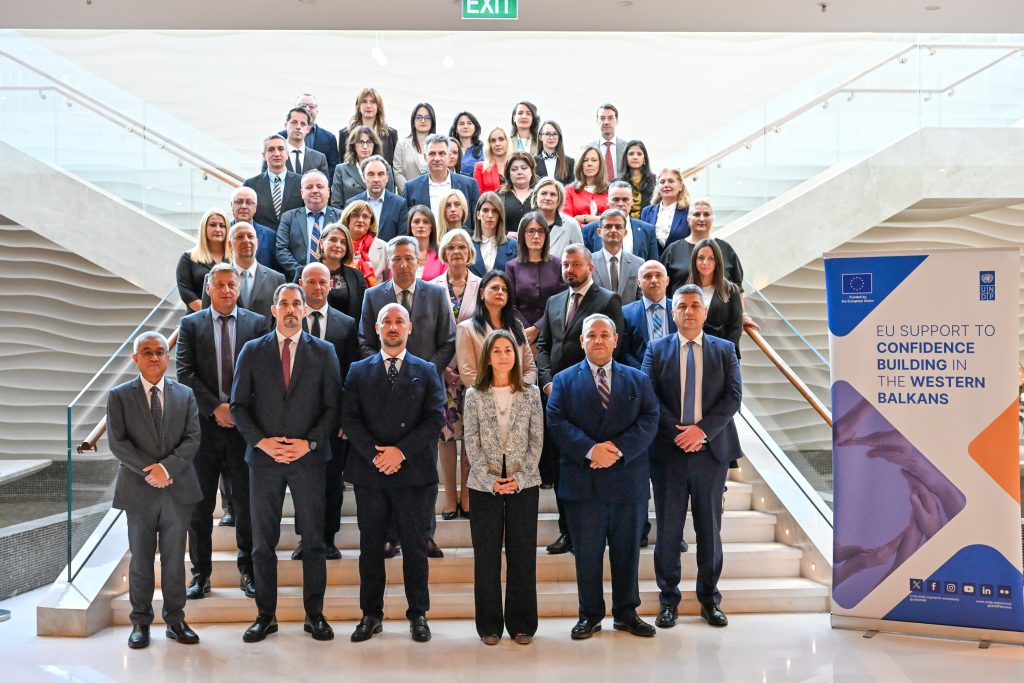
The State Prosecutor’s Office of Montenegro has demonstrated its readiness to prosecute war crimes within the shortest possible timeframe, while strengthening direct cooperation and the exchange of evidence with other prosecution services in the region is also essential for achieving this goal, it was stated at a regional conference dedicated to cooperation in war crimes proceedings. Montenegro’s Supreme State Prosecutor Milorad Marković and Chief Special Prosecutor Vladimir Novović participated in the conference.
The conference, held in Skopje on 23 and 24 September, focused on improving regional cooperation in the prosecution of war crimes, with the aim of accelerating and facilitating the prosecution of perpetrators of the most serious criminal offences through stronger partnerships and concrete steps.
During the gathering, participants exchanged experiences concerning the collection and transfer of evidence, emphasizing that such evidence must be obtained in strict accordance with the law, be admissible, and meet high-quality standards in order to support fair judgments before the courts.
Particular attention was also devoted to the important legal principle that prevents a person from being tried or punished twice for the same offence in different countries (ne bis in idem), on which Special Prosecutor Tanja Čolan Deretić had the opportunity to speak.ne bis in idem), o čemu je imala priliku da govori specijalna tužiteljka Tanja Čolan Deretić.
The second day of the conference was dedicated to cooperation with the International Residual Mechanism for Criminal Tribunals, further strengthening the ties between prosecution services in the region and international judicial institutions.
As part of the conference, representatives of the Montenegrin prosecution service held discussions with state prosecutors from the region on concrete steps for further cooperation, as well as on the implementation and improvement of existing cooperation agreements.
The conference is organized within the framework of the project “EU Support for Confidence-Building in the Western Balkans,” funded by the European Union and implemented by the United Nations Development Programme (UNDP).