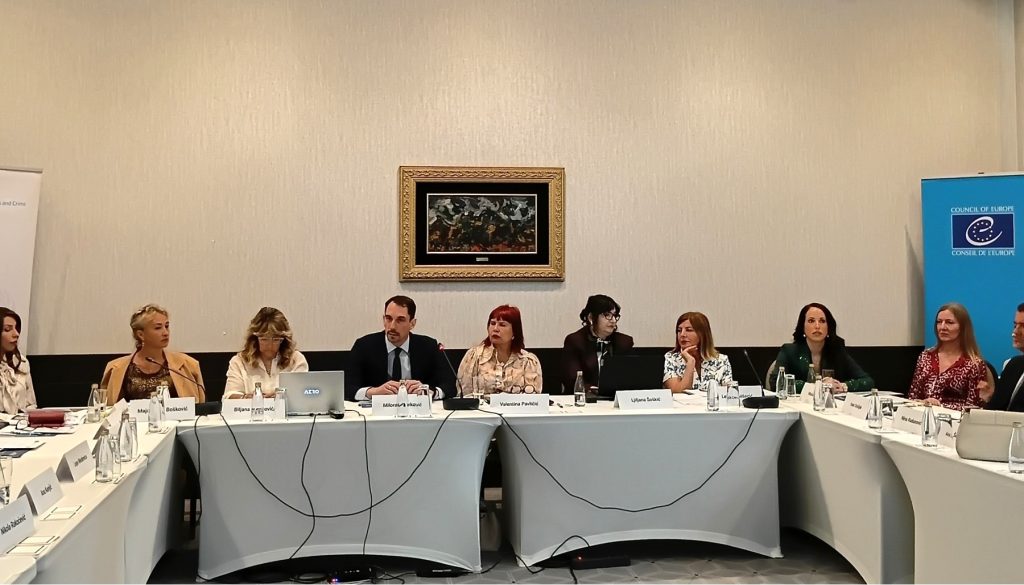
Supreme State Prosecutor Milorad Marković today opened the two-day training programme entitled “Strengthening the Ethical and Disciplinary Accountability of Judges and Prosecutors,” organized by the Council of Europe with the support of the European Union and the United Nations Office on Drugs and Crime (UNODC).
Addressing the participants, Marković emphasized that professional integrity, impartiality, and accountability are essential prerequisites for maintaining public trust in judicial institutions and strengthening the rule of law.
“Judicial independence is one of the fundamental values of a democratic society, but it also entails a high degree of professional and ethical responsibility. Effective, fair, and transparent accountability mechanisms do not undermine the independence of judicial office holders; on the contrary, they further reinforce it and contribute to strengthening public confidence in institutions,” Marković stated.
Marković paid particular attention to younger colleagues attending the training, stressing that programmes of this kind are especially important at the beginning of a professional career, as they contribute to a better understanding and consistent application of ethical and disciplinary standards in everyday work.
He underlined that building a professional culture based on integrity, ethics, and accountability is one of the most important prerequisites for the further improvement of judicial institutions and for achieving the highest European standards.
The training will address international and national standards of judicial and prosecutorial ethics, disciplinary accountability, procedural safeguards in disciplinary proceedings, as well as the challenges faced by judges and prosecutors in applying ethical principles in their daily work. Special attention will be devoted to issues of conflict of interest, safeguarding independence from undue influence, and strengthening institutional integrity.
The participation of representatives of the prosecution service in programmes of this kind represents a significant contribution to the further enhancement of professional capacities, the exchange of experiences, and the implementation of best European practices in the fields of ethics, accountability, and integrity of judicial office holders.
In addition to the Supreme State Prosecutor, the opening session was also addressed by Valentina Pavličić, President of the Supreme Court of Montenegro; Ljiljana Šoškić, Chair of the Governing Board of the Training Centre for the Judiciary and State Prosecution Service; and Lejla Dervišagić, Head of the Council of Europe Programme Office in Podgorica.