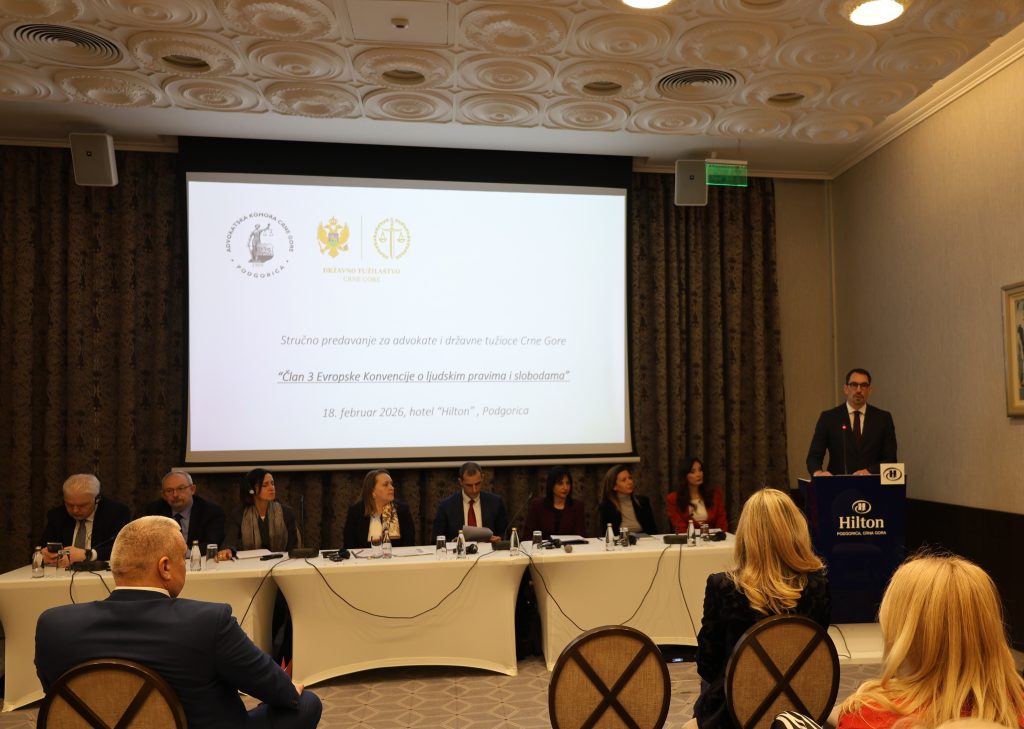
Supreme State Prosecutor Milorad Marković addressed attorneys and state prosecutors at a conference dedicated to Article 3 of the European Convention on Human Rights, organized by the Bar Association of Montenegro in cooperation with the Supreme State Prosecutor’s Office.
“The protection of human rights and the application of the standards stemming from Article 3 of the Convention, which relates to the prohibition of torture and inhuman or degrading treatment, are not the responsibility of a single institution, but a shared obligation of all those involved in the administration of justice,” Marković stated.
He emphasized that the responsibility and professionalism of attorneys, just like that of prosecutors, form the foundation of public trust in the judiciary. Without that trust, he noted, no legal system can be truly strong. In a system based on the rule of law, a lawyer has an irreplaceable role — as a guardian of procedural rights, a guarantor of a fair trial, and an essential pillar of the justice system. The quality of justice, he added, depends not only on court decisions and prosecutorial actions, but also on the professionalism and expertise of the legal profession.
Marković reminded that it is not enough for the state merely to refrain from committing torture; it must actively prevent abuse, protect persons deprived of liberty, ensure adequate detention conditions, and conduct effective, impartial, and prompt investigations into every allegation of ill-treatment, in line with the case law of the European Court of Human Rights.
He pointed out that the contemporary practice of the European Court shows that protection against inhuman and degrading treatment is not limited to classic cases of police torture or poor prison conditions, but is also developing and being applied in the context of systemic, particularly gender-based, violence. “Gender-based violence is now recognized as a human rights issue, not merely a criminal law problem,” he stressed.
The Supreme State Prosecutor underlined that the state’s obligation is threefold — preventive, protective, and repressive. Institutions must identify risks in a timely manner, undertake protective measures, and ensure that perpetrators are prosecuted in a way that confirms zero tolerance for violence.
A special segment of the presentation was dedicated to guidelines for handling cases involving suspected violations of Article 3 of the Convention and cases of domestic violence. Through their implementation, the standards of the European Court of Human Rights become a binding model of conduct in the work of state prosecutor’s offices. The guidelines send a clear institutional message that in cases of torture and violence there is no room for differing interpretations, inconsistent practice, or delayed response, and that standards of conduct are mandatory, while also protecting both citizens’ rights and the professional integrity of prosecutors.
Regarding the implementation of the Guidelines for handling cases of domestic violence or violence within a family community, Marković stated that 466 cases were formed in 2023, 977 in 2024, and as many as 1,877 in 2025. These figures, he emphasized, reflect not only a quantitative increase, but also a greater readiness of institutions to recognize and prosecute violence, as well as increased encouragement of victims to report it.
The coordinators of the guidelines, state prosecutors at the Higher State Prosecutor’s Office, Danka Ivanović Đerić and Ana Radović, presented notable results in cases of torture and gender-based violence, confirming that human rights protection standards are becoming concrete and applicable practice in the work of prosecutor’s offices.